

He never asked to be an icon
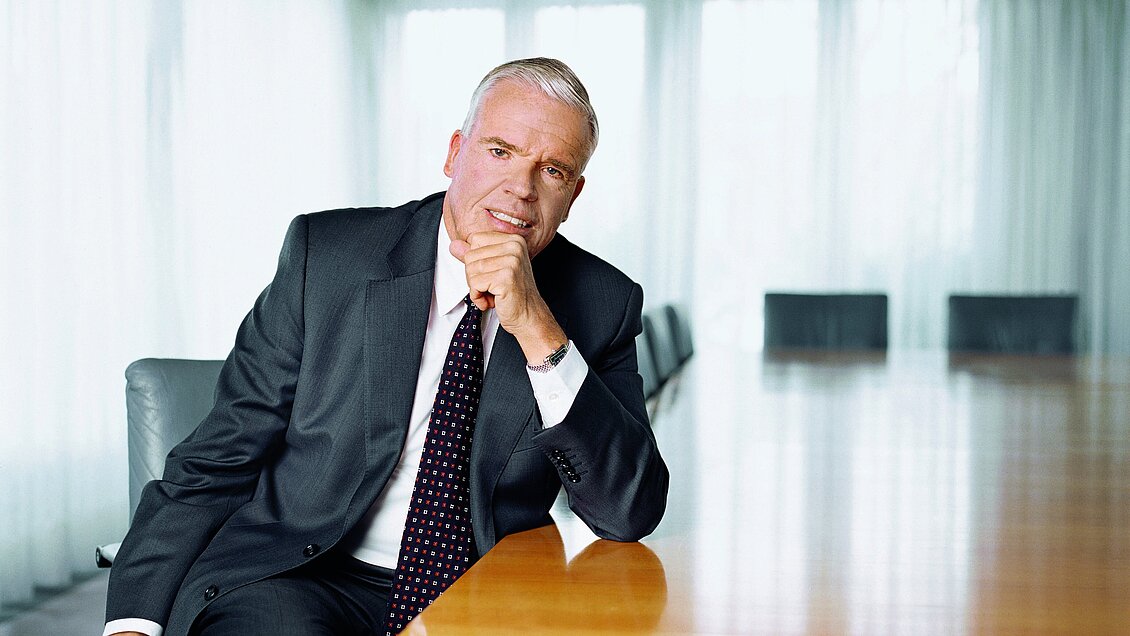
Klaus-Michael Kühne had a modest view of himself. “I’m no legend,” he once said in an interview on the DVZ’s ‘Red Sofa’. “If you say that again, you’ll receive a serious warning, if not a red card,” joked the HSV investor. He did not see himself as a legend and had no desire ever to become one. He was a normal person and a “man of action”. The life’s work of this normal person is Kühne + Nagel.
Kühne was a freight forwarder through and through. He took over the reins of the company at the early age of 29 from his father Alfred and transformed the family business into one of, if not the, world’s leading logistics group, which today employs around 88,000 people across over 1,300 locations in almost 100 countries. In doing so, he consistently developed Kühne + Nagel from a traditional freight forwarding business into an integrated, asset-light logistics group. That is his lifetime achievement as an entrepreneur.
Thinking holistically from an early stage
Kühne recognised the internationalisation of trade at an early stage and focused on establishing a strong presence in key trading regions. He also prioritised businesses where global networks and expertise were more important than owning as many of his own transport vehicles as possible. “He thought holistically earlier than others,” a former KN manager recalled in an interview with the DVZ. This approach characterised his entire professional life: right up until the end, he remained open to innovative ideas.
As a result, the world will become increasingly efficient. Whether this will make it a better place remains to be seen. Kühne speaking to the DVZ on increasing digitalisation, 1 October 2017
For many years, the industry has often regarded Kühne + Nagel as the benchmark in the freight forwarding and logistics sector. The industry watched Kühne’s decisions – for example, regarding the design of management structures, process improvements, or the focus on so-called verticals – with a watchful eye and often with admiration.
Internally, he was demanding. Kühne often expected the impossible from his staff in order to get the very best out of them. He held himself to the same high standards: the logistics billionaire was regarded as extremely hard-working right up to the end. He always put the company above everything else – even himself, as another long-standing colleague confirms. And if complacency began to take hold amongst the management, he would grow dissatisfied and issue warnings and demands.
At the same time, however, he placed his trust in his closest colleagues and gave them scope to make decisions, taking a genuine interest in the people he worked with. Even though he often came across as aloof and unapproachable in public, he certainly had a sense of humour – a subtle one, according to those in the know.
There was one area, however, where Kühne had absolutely no sense of humour: he disliked any waste of resources – be it time, money, or materials. A legendary example: in the days of traditional postal services, managers flying from Hamburg to Zurich had to take letters and courier parcels back to head office with them – and do the same on the return journey. Despite all his entrepreneurial success, he always exemplified thrift and modesty: he did not fly in a company jet, but on scheduled flights, and he travelled from Berlin to Hamburg by ICE.
Unfazed by change
Kühne always took an open-minded view of technological and global changes, without placing blind trust in them. He viewed change and transformation with composure. Kühne saw progress less as a radical break and more as the logical continuation of a long technical and economic development. Thus, what the manager said about digitalisation in 2017 can now be applied to artificial intelligence. It has “swept us all up” and will continue to spread, although the level of development varies greatly from company to company. Today’s possibilities are leading to “enormous changes in processes and in the entire workflow”. And this is not limited to logistics, but affects the everyday lives of everyone.
Humanity will never become reasonable and peaceful; we must accept that. Kühne speaks to the DVZ on geopolitical developments, 1 October 2017
What is striking in this context is how quickly the digital transformation has taken hold in Kühne’s personal media consumption. As recently as 1 October 2017, he was still professing his conservative reading habits: he preferred to read a printed newspaper, leaf through it, and choose for himself what interested him, rather than clicking his way through content online. Just a few months later, on 1 February 2018, he was already describing himself as decidedly more digital: consuming information on his mobile phone had, he said, “become automatic” for him.
In terms of economic policy, Kühne was a staunch internationalist. “I am a great supporter of globalisation,” he said. The world had now grown so closely interconnected that it was no longer possible to draw sharp dividing lines.
No exaggerated illusions
Yet Kühne was no naive optimist. The geopolitical tensions of recent years had affected his company as well. He was convinced that global economic relations were becoming more efficient. As to whether this would also make the world a better place, he harboured doubts. “Humanity will never become reasonable and peaceful; we have to live with that.”
His sober view of events formed the basis for his business success in the long term. In his life, he had experienced many ups and downs, setbacks, and surprising developments. Yet life always continued, and often things did not turn out as badly in the end as had initially been predicted.
Kühne showed no hesitation in dealing with crises. This is evident from his commitment to humanitarian logistics. The Kühne Foundation, a charitable organisation he established in 1976, supports aid organisations in Africa, the Middle East, and South-East Asia, amongst other regions. It advises non-governmental organisations, which often lack the logistical expertise needed to deliver aid supplies quickly to those affected in crisis situations.
I am seriously concerned about the port: it is poorly organised, poorly managed, and cannot compete with some of the other seaports. Kühne in the “Hamburger Abendblatt” on the future of the Port of Hamburg, 1 September 2023
Kühne has recognised the need in this area. In Africa in particular, the importance of effective logistics for humanitarian aid is evident. The fact that one of the world’s largest logistics service providers has shared its expertise has significantly benefited the work of aid organisations. Kühne therefore called on companies in the sector to devote greater and more focused attention to this issue.
Supporting the next generation
He also used his wealth not only to make numerous investments in companies, but also, through his foundation, to support education and training, as well as research and science in the fields of logistics and transport management. His foundation also funds chairs and supports universities. The patron recognised that there was a need for more qualified workers at all levels. With the Kühne Logistics University in Hamburg’s HafenCity, he established a specialised higher education institution offering bachelor’s and master’s degree programmes and attracting students from many countries.
Throughout his life, this lover of art and opera remained emotionally attached to his home city of Hamburg, even though he had lived in Switzerland since the 1960s. This is evidenced by his emotional investments in, for example, HSV, the Elbphilharmonie, and the planned new opera house in the Hanseatic city. At the same time, his acquisition helped keep the shipping company Hapag-Lloyd in Hamburg.
However, whenever Kühne got involved, he also wanted to have his say. He was outspoken, combative, and openly advocated positions that were the subject of heated debate. But never for the sake of having a say, rather out of conviction – just as he did throughout his life at Kühne + Nagel.
Kühne and his life’s work send a message to the logistics industry. It is this: the sector must transform itself and, in doing so, must not forget what its capabilities are needed for – for a functioning economy, for skilled people, and, ideally, for providing concrete help in a world in crisis.