


Bundeswehr seeks firmer pledges from logistics industry

Germany’s armed forces want civilian logistics providers to set out what they can deliver in a contingency. At the first DVZ Defence Logistics Conference in Berlin, Major General Jochen Deuer, commander of the Bundeswehr’s logistics command, which covers depots and supply for forces at home and abroad, told about 180 executives that Germany also served as a logistics hub for multinational partners. Deuer said planning focused on three tests: readiness, the ability to deploy and the ability to sustain operations. With about 260,000 active personnel and 200,000 reservists, he argued that commercial companies would be essential for transport, spare parts and vehicle maintenance, and questioned how robust their commitments would be. He called for predictable funding, noting that parts of a 500 billion euros special fund had already been used for transport vehicles and handling equipment. Hans Christoph Atzpodien, head of the defence industry association BDSV, urged cuts to bureaucracy. He pointed to the SVI platform, launched on 1 January 2026, where firms can register as potential suppliers to defence-industry supply chains. Several speakers cited 2029 as a possible timeframe for a Russian attack on Nato.
“Defence is a task for society as a whole.” With these words, Major General Jochen Deuer, Commander of the Bundeswehr Logistics Command, addressed 180 logistics specialists. The role of the civilian economy is central and indispensable in this regard.
Germany is also a logistics hub for multinational partners. “And you will be a key player in this.” With these clear words, Major General Jochen Deuer, Commander of the Bundeswehr Logistics Command, addressed 180 business leaders who had travelled to Berlin for the 1st DVZ Defence Logistics Conference. Last Monday, the day-long event focused on global threats, hybrid attacks on businesses, Germany’s defence capabilities, and, within this complex landscape, the role of logistics.
Deuer is responsible within the Bundeswehr for the overall logistics concept, for sub-areas such as depots and thus for the supply of German forces at home and abroad. “This includes all services such as transport, spare parts supply, and vehicle maintenance,” explains the Major General. However, he is not solely responsible. There are also logistics units within the Army, the Air Force, and the Navy.
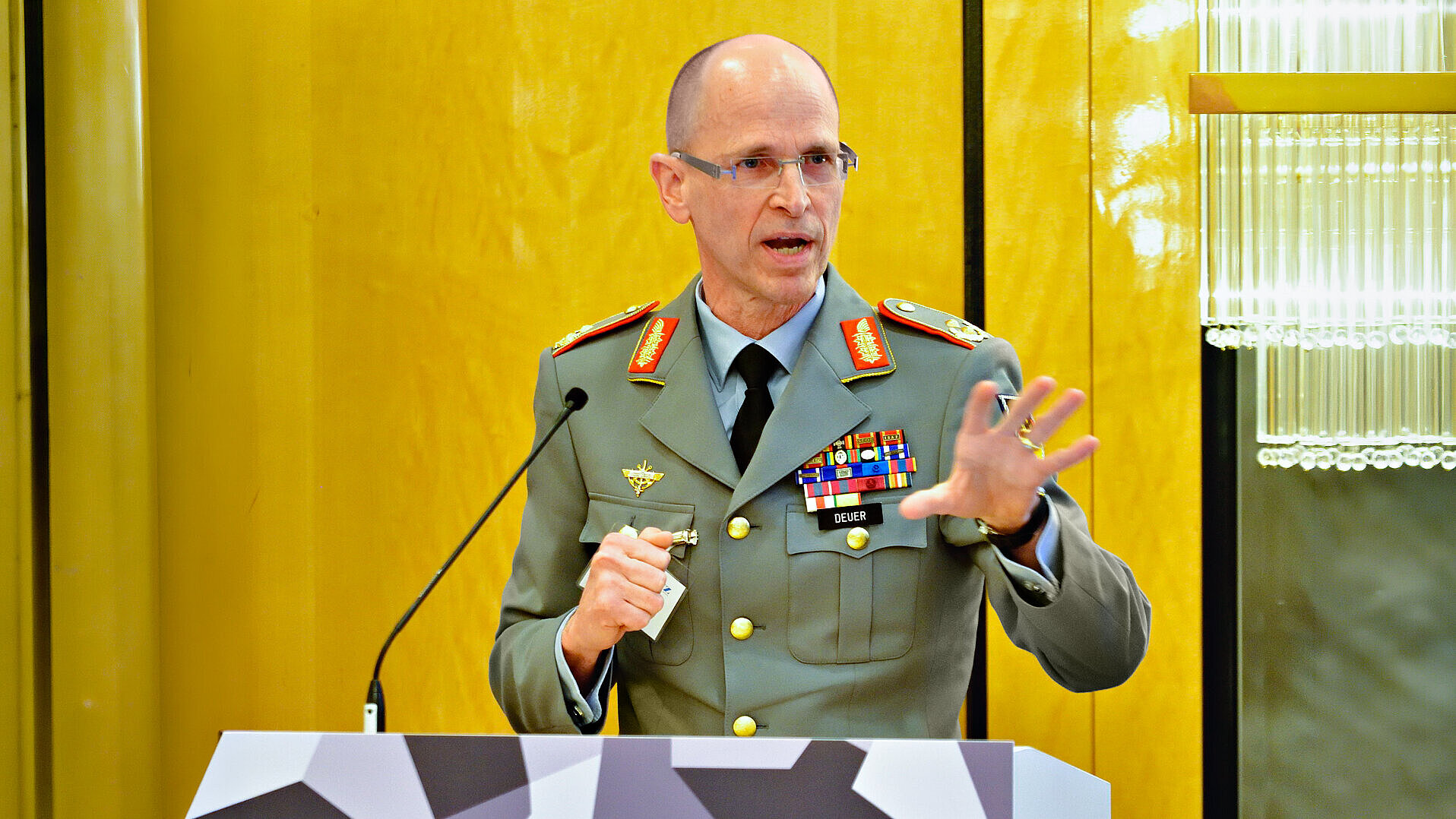
In the event of a conflict, three factors are key for Deuer: operational readiness, deployability, and sustainability. However, military resources are limited. The Bundeswehr currently has 260,000 active and 200,000 non-active personnel. Civilian logistics companies are crucial for supply. “Defence is a task for society as a whole,” says Deuer. For this reason, it is important for him to know: “How reliable are your commitments in the end?”
Alongside Germany’s role as a hub, the Major General prioritises Germany’s defence capability above all else. Predictable funding is important to him. Parts of 500 billion euros from the special fund for the Bundeswehr flowed smoothly last year – for transport vehicles and handling equipment.
Platform for service providers
However, alongside funding, reducing bureaucracy is also necessary, noted Hans Christoph Atzpodien, Chief Executive of the Federal Association of the German Security and Defence Industry (BDSV). The Federal Association for Materials Management, Purchasing and Logistics, in collaboration with the Federal Ministry for Economic Affairs and the BDSV, has set up the SVI platform and launched it on 1 January 2026. Companies wishing to network within the defence industry’s supply chains and make themselves available as potential suppliers can register there.
During the conference, 2029 was frequently cited as a possible year in which Vladimir Putin might be in a position to attack NATO. Russia had made a mistake in its logistics during the attack on Ukraine. “They will never make that mistake again,” said Deuer. That is why he was glad that the Bundeswehr was now preparing itself better.
Following his presentation and a panel discussion, a long queue formed at Deuer’s lectern, as many participants clearly had a great need to talk and still had a great many questions.