What Germany´s export-economy needs for survival
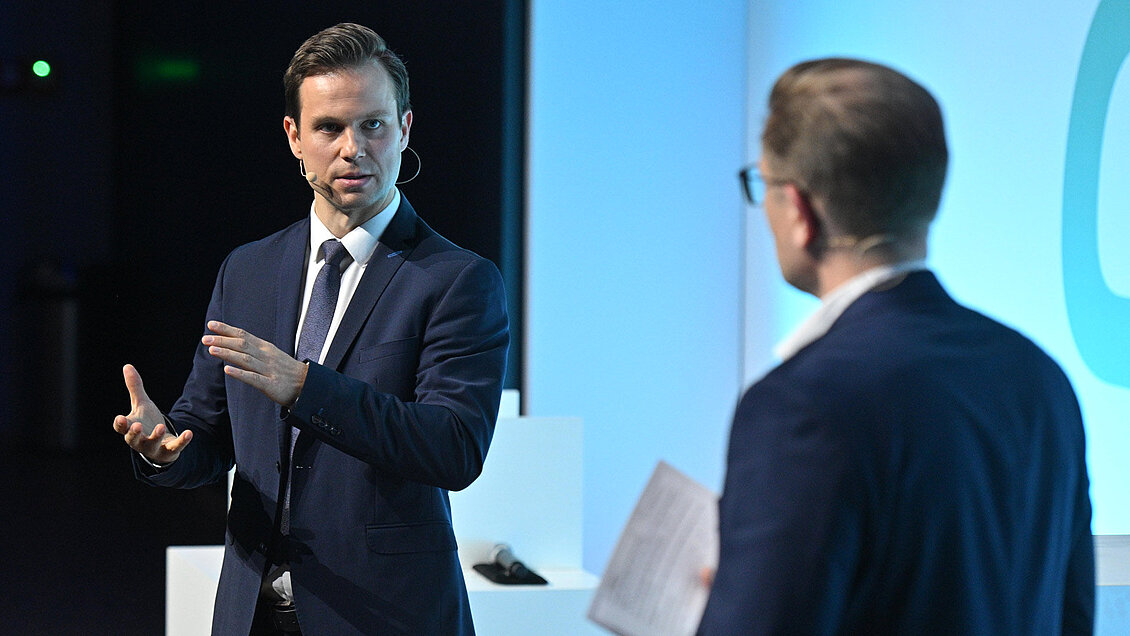
The global economy is becoming increasingly unpredictable. Trade conflicts are intensifying and German exports are coming under pressure. Yet, according to Vincent Stamer, there can be no question of deglobalisation. “To me, that’s just a rumour,” said the senior economist at Commerzbank at the BVL Supply Chain CX in Berlin. Following his presentation, he discussed the consequences of geopolitical tensions, new trade relationships, and the outlook for the German economy with DVZ editor-in-chief Sebastian Reimann.
Stamer bases his assessment on trends in world trade: its share of global economic output has been stagnating since around 2008, but has not fallen. At the same time, the global economy and trade continue to grow. The economist therefore sees the decisive change not so much in an end to globalisation, but rather in a shift in trade flows and increasing uncertainties.
Between China and the US
Germany is under particular pressure as a result of the competition between the two largest economies. Whilst US President Donald Trump is protecting the American market with tariffs, China is strengthening its position in global supply chains through extensive subsidies. This places Germany in a geopolitical ‘vice’: the US remains the most important market for German exports, whilst exports to China have fallen significantly. Added to this is the fact that Chinese products are increasingly competing with German goods in third-country markets.
The consequences of the US tariffs are also likely to persist for longer than many companies expect. Supply chains take two to three years to adapt to new trading conditions. Consequently, the tariffs introduced in 2025 could still be having a dampening effect as late as 2027.
New markets, new opportunities
Stamer is pinning his hopes on new trade agreements by the European Union. Whilst the agreement with the South American Mercosur states is already in force, the agreement with India is about to be implemented. The economist expects European exports to India to double over the next ten years, a trend that the removal of tariffs will significantly boost.
However, India cannot replace China as a production base in the short term. The differences between India’s states, as well as the hurdles in contract and tax law, are still too great for that. Africa also offers considerable opportunities, for example for the German mechanical and plant engineering sector. However, many countries still lack the institutional framework necessary for dynamic economic development. The continent’s potential has been touted for decades without it having been realised everywhere, Stamer warned.
France remains a risk
Stamer also sees uncertainties within Europe. France’s rising budget deficit and the lack of a political majority for austerity measures are causing concern on the financial markets. Nevertheless, the Commerzbank economist considers a new euro crisis to be less likely: in his view, the risk is below 50 per cent.
As for Germany, Stamer sees cause for optimism despite structural problems. Whilst exports have weakened and high energy costs and bureaucracy are weighing on competitiveness, orders from European partner countries are picking up again. Demand in the industrial and services sectors is also beginning to recover. Germany continues to have the necessary economic capacity to weather an economic downturn. It is crucial to capitalise on these strengths and adapt to new markets.